
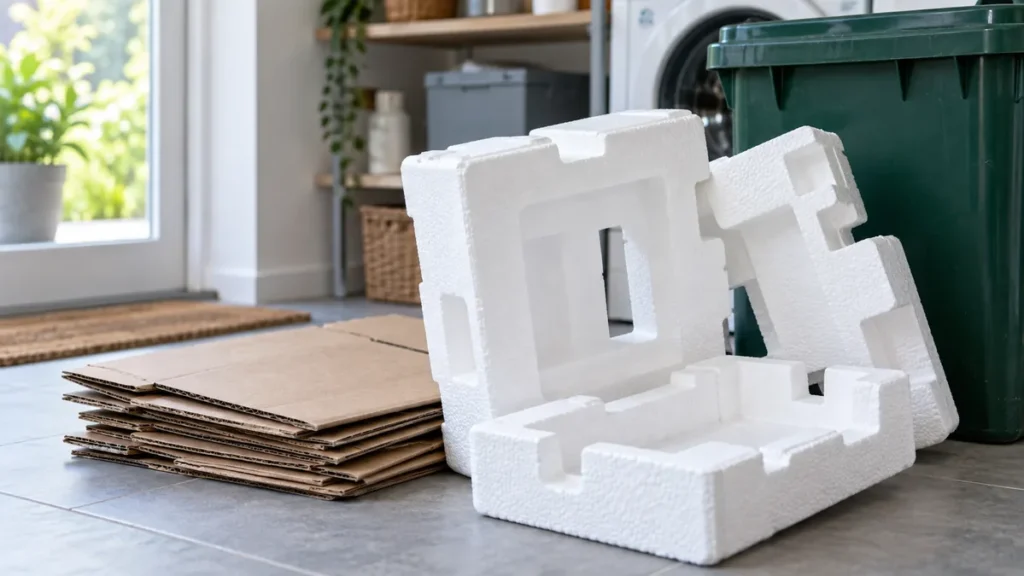
Polystyrene is technically recyclable, but it is not usually accepted in UK household recycling bins. Clean expanded polystyrene (EPS) can be processed by some specialist facilities and recycling centres, but local services vary. Always check your council’s current guidance before putting polystyrene in household recycling.
That difference between being technically recyclable and accepted locally is the source of much of the confusion. Although suitable equipment can process certain types of polystyrene, collecting and transporting the material is often difficult and uneconomical.
This guide explains which types may be recycled, whether polystyrene can go in your household bins and what to do with packaging, food containers, insulation and larger quantities of waste.
Table of Contents
Is Polystyrene Recyclable in the UK?
Yes, some polystyrene can be recycled in the UK, but access to a suitable collection service is limited.
Whether a particular item can be recycled depends on:
- The type of polystyrene
- Whether it is clean and dry
- Whether it contains tape, labels, food or other materials
- The quantity you need to dispose of
- The facilities available in your area
In England, expanded and high-impact polystyrene packaging is among the plastic waste that household collectors are not required to collect. The government also says local authorities should tell residents clearly what can and cannot go into each waste stream. You can read the current requirements in the government’s Simpler Recycling guidance.
For that reason, there is no single bin rule that every UK household should follow. If your council does not expressly list polystyrene as an accepted recyclable, keep it out of your recycling bin.
Can You Recycle Polystyrene in Your Household Bin?
Most UK kerbside recycling services do not accept polystyrene, especially the lightweight white foam used to protect furniture, televisions and kitchen appliances.
Foam polystyrene can break into small beads during collection and sorting. These fragments may mix with paper, card and other plastics or cause problems for sorting machinery. Putting an unaccepted item in the recycling can therefore contaminate other material rather than give the item a second life.
London Recycles’ polystyrene guidance advises residents not to place polystyrene in mixed recycling. However, London is served by multiple waste authorities and boroughs, so residents should still check their own council’s recycling A–Z.
The safest rule is straightforward: only put polystyrene in household recycling when your local authority specifically says it is accepted.
What Types of Polystyrene Are There?
Polystyrene is not limited to the familiar white foam. It is manufactured in several forms, and the difference matters when you are looking for a recycling or disposal route.
| Type | Common examples | Recycling position |
|---|---|---|
| Expanded polystyrene (EPS) | Appliance packaging, protective blocks and packing beads | Technically recyclable, but normally requires a specialist facility |
| Extruded polystyrene (XPS) | Dense insulation boards and some foam products | Not normally accepted in household recycling |
| Rigid polystyrene | Some containers, plastic housings and older CD cases | Technically recyclable, but local collection is uncommon |
| Food-contaminated polystyrene | Used trays and food containers | Usually unsuitable for recycling because of contamination |
Expanded polystyrene packaging
Expanded polystyrene, usually shortened to EPS, is lightweight foam made from small fused beads. It is commonly moulded into protective corners and blocks for appliances, electronics and furniture.
Clean white EPS packaging is one of the forms most likely to be accepted by a specialist recycler. Facilities may require it to be dry and free from:
- Food residue
- Tape and sticky labels
- Cardboard
- Plastic film
- Dirt and building debris
Do not break it into small pieces unnecessarily. Loose beads are harder to contain and can escape during storage or transport.
Rigid polystyrene
Rigid polystyrene is solid rather than foamed. It may be used in plastic housings, containers and other moulded products. Some items display the resin identification code PS 6.
The number identifies the type of plastic; it does not guarantee that the product can go into your local recycling collection. Recycling symbols should always be checked against your council’s accepted-material list.
Polystyrene food packaging
Grease, sauces and food residue make polystyrene difficult to process. Used food trays and takeaway containers are therefore generally unsuitable for recycling.
England has prohibited the supply of certain single-use expanded and extruded polystyrene food and drink containers. The official single-use plastics guidance explains which products are covered. However, the restriction does not make older containers recyclable, and it does not apply to every polystyrene product.
If you encounter polystyrene food packaging, follow your council’s instructions. Where no accepted recovery route exists, it will normally need to go into general waste.
Polystyrene insulation
EPS and XPS are also used as insulation in construction. Offcuts from building work may contain adhesive, render, dust or other contaminants, so they should not be treated in the same way as clean appliance packaging.
Do not put insulation in household recycling. Ask your local household waste recycling centre whether it accepts the material, or arrange appropriate building waste removal in London for larger renovation quantities. Describe the insulation accurately when making an enquiry so the collector can confirm whether it can be accepted.
Why Is Polystyrene Difficult to Recycle?
The main problem is not that polystyrene is impossible to process. The challenge is collecting a clean, useful quantity efficiently.
It has a low density
EPS contains a great deal of air. A collection vehicle can fill up with bulky foam while carrying relatively little recoverable plastic. This makes transport inefficient unless the material can be compacted near its source.
It breaks into small pieces
Foam blocks can crumble into lightweight beads. These pieces are difficult to contain and may become mixed with other recycling during collection and sorting.
It is easily contaminated
Food, grease, adhesive tape, labels and building materials can make polystyrene unsuitable for a recycling process that requires a clean input.
Specialist equipment is not widely available
Many household recycling systems are designed around high-volume materials such as paper, card, metal cans, glass bottles and commonly collected plastic packaging. Polystyrene often requires a separate collection and specialist compacting equipment.
These issues explain why the answer to “can polystyrene be recycled?” is technically yes, while the practical answer for many households is “not through the usual recycling bin”.
How to Dispose of Polystyrene Responsibly
Use the following process before putting polystyrene in the rubbish:
- Identify the material. Decide whether it is EPS packaging, rigid polystyrene, a food container or insulation.
- Separate other materials. Remove cardboard, film, tape and labels where this is safe and practical. Recycle each accepted material separately.
- Keep usable EPS clean and dry. Specialist facilities are more likely to accept clean packaging than contaminated foam.
- Check for reuse. Intact packaging may be useful for another move, storing fragile items or sending a product safely. Ask before giving it to a local business or community group.
- Check your council’s website. Look for its waste and recycling A–Z and review both kerbside and recycling-centre instructions.
- Confirm before travelling. Opening hours, booking systems, proof-of-address rules and accepted materials can change.
- Ask the retailer. When receiving an appliance or furniture delivery, check whether the retailer can take its packaging back.
- Use a suitable collection service for large quantities. This may be more practical after a move, clearance or renovation.
- Use general waste only when no accepted reuse or recycling route is available. Do not put polystyrene into recycling in the hope that it will be sorted later.
Never burn polystyrene or dissolve it using household chemicals. These are unsafe disposal methods and do not create a suitable household recycling route.
Can Expanded Polystyrene Be Recycled?
Expanded polystyrene can be recycled when it is collected separately and sent to a facility with the right equipment. It can be compacted to remove much of its volume before the plastic is reprocessed.
Public access to this service is inconsistent. For example, the North London Waste Authority lists selected reuse and recycling centres that accept expanded polystyrene. Its guidance distinguishes the sturdy EPS packaging used around large appliances from polystyrene takeaway containers.
This is a useful example of why local checking matters: availability at selected North London sites does not mean that every London recycling centre or kerbside service accepts EPS.
Businesses or organisations producing a regular supply of clean EPS may have more specialist options than a household with one or two packaging blocks. Acceptance may depend on volume, colour, cleanliness and transport arrangements.
Can Polystyrene Packaging Be Recycled?
Clean packaging from televisions, computers, furniture and appliances has a better chance of finding a specialist route than food-contaminated material.
When unpacking a large delivery:
- Flatten and recycle the cardboard separately if your collection accepts it.
- Remove plastic film and check whether it has a separate collection route.
- Keep clean EPS blocks together and dry.
- Ask whether the retailer offers packaging take-back.
- Check local recycling centres before using general waste.
Clean packing beads may also be reusable. Local online sellers or removal businesses might have a use for them, but contact the recipient first and keep the beads securely contained.
Can Polystyrene Go in the General Waste Bin?
If your council does not accept polystyrene and you cannot find a reasonable reuse, take-back or specialist recycling option, small household quantities will usually need to go into general waste.
Follow your council’s instructions and contain the material so that lightweight pieces cannot escape. Do not leave it beside communal bins or at a recycling centre that does not accept it.
General waste is the fallback rather than the preferred first step. Clean EPS is worth checking because some areas provide a dedicated drop-off route.
What Should You Do With Large Amounts of Polystyrene?
Large volumes often appear after moving home, replacing several appliances, fitting out an office or renovating a property. Before arranging collection, separate the polystyrene from cardboard, electrical equipment, metal, timber and general rubbish.
Homeowners and landlords clearing mixed household items can consider a bulky waste collection service. For a wider property clear-out, house clearance in London may be the more relevant service.
Businesses should use an appropriately registered waste carrier and keep any documentation required for their waste. The government provides a public service to check a waste carrier’s registration.
For office packaging and other business waste, One Call Home Services also offers commercial waste collection in London. State clearly that the load contains polystyrene when requesting a quote, and ask how it needs to be separated and where it is expected to go.
Need help clearing bulky waste in London? Explore same-day waste removal in London and describe the type, condition and approximate volume of material when you enquire.
Polystyrene Recycling FAQs
Is polystyrene recyclable in the UK?
Polystyrene is technically recyclable, but most UK household recycling collections do not accept it. Clean expanded polystyrene may be accepted by selected recycling centres or specialist processors. Check the latest rules for your local authority.
Can I put polystyrene in my recycling bin?
Only if your council specifically says it is accepted. In most areas, polystyrene should not go into mixed household recycling because it can break apart and contaminate other materials.
Can expanded polystyrene packaging be recycled?
Yes, clean EPS packaging can be recycled at suitably equipped facilities. Local access is limited, and acceptance conditions vary. Remove other packaging materials and contact the facility before visiting.
What does the number 6 on polystyrene mean?
The number 6 is a resin identification code for polystyrene. It identifies the plastic but does not mean that your council accepts the item for recycling.
Can polystyrene food packaging be recycled?
It is rarely accepted, particularly when contaminated with food or grease. Follow your council’s instructions and use general waste if no approved recycling route is available.
Where can I recycle polystyrene near me?
Check your council’s recycling A–Z and the accepted-material lists for nearby household waste recycling centres. A postcode-based service such as the Recycle Now Recycling Locator can also help, but confirm the details with the receiving facility before travelling.
Is polystyrene biodegradable?
Conventional polystyrene is not biodegradable or suitable for home composting. Reuse it where practical or follow an approved local recycling or waste-disposal route.

