
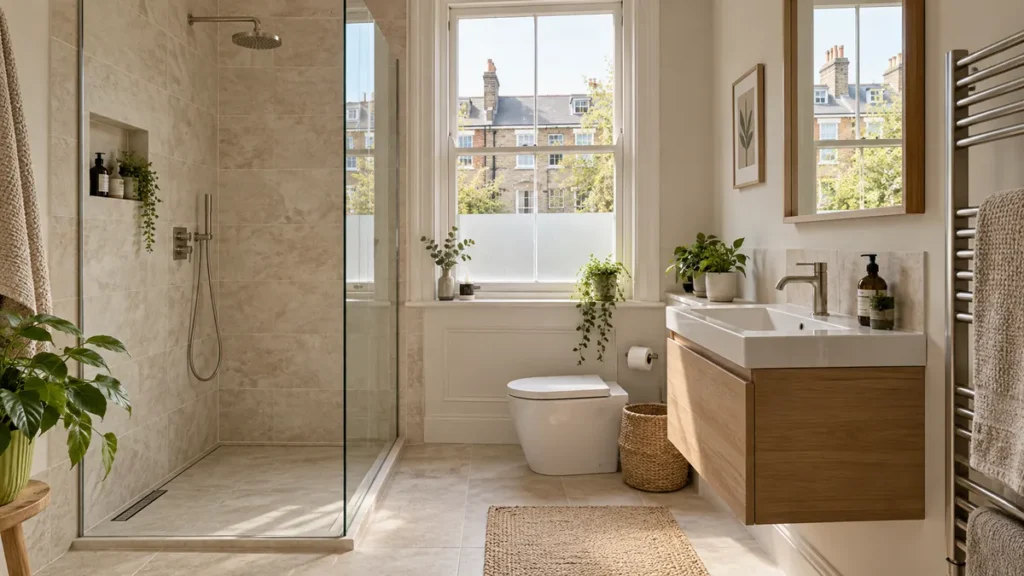
How much is a new bathroom? In 2026, a typical complete bathroom costs approximately £5,500–£8,000 in the UK. In London, allow roughly £8,000–£15,000 for a mid-range renovation. A basic refresh may cost less, while premium finishes, layout changes and structural work can take the total above £20,000.
Those figures are estimates, not fixed prices. “New bathroom” can mean anything from replacing a suite in the same positions to stripping the room back, moving drainage, waterproofing, tiling and completing all electrical and decorative work. An accurate quotation requires a property inspection and an agreed specification.
Table of Contents
How much is a new bathroom in the UK?
Checkatrade’s updated 2026 national guide gives £5,500–£8,000 including materials as a typical new bathroom cost. A project can fall below that range when it is a limited, like-for-like refresh using budget products. Full reconfiguration, extensive tiling or designer products can increase it substantially.
| Project type | Estimated UK cost | Estimated London cost | Typical duration |
|---|---|---|---|
| Basic bathroom refresh | £3,000–£5,500 | £4,500–£8,000 | 4–7 working days |
| Small bathroom renovation | £4,500–£7,500 | £6,000–£10,000 | 5–10 working days |
| Standard complete bathroom | £5,500–£9,000 | £8,000–£13,000 | 7–12 working days |
| Mid-range bathroom renovation | £7,000–£12,000 | £10,000–£16,000 | 10–15 working days |
| Premium bathroom renovation | £12,000–£25,000+ | £15,000–£30,000+ | 15–25+ working days |
These combined guide ranges assume an existing bathroom of ordinary size. At the lower end, expect a retained layout and controlled product allowance. At the upper end, expect more preparation, full-height tiling, higher-specification fixtures or layout changes. Confirm whether VAT is included in every quotation.
New bathroom cost in London
London prices reflect more than a simple labour premium. Parking charges, congestion and restricted delivery times can reduce productive hours. Waste may have to be carried through a flat or protected communal hallway, and a skip might require permission or be impossible to place.
Older terraces and converted flats may also have ageing pipework, uneven substrates and awkward soil-stack access. In leasehold property, the freeholder or managing agent may require approval, contractor insurance details, set working hours or protection for common areas.
For these reasons, many London homeowners should use £8,000–£15,000 as a sensible planning range for a complete mid-range renovation. Central locations, difficult access, a premium specification or major changes can push the cost higher.
Bathroom cost by renovation level
Budget bathroom
A budget project normally keeps the toilet, basin and bath or shower in their current positions. It uses reliable entry-level sanitaryware, limited tile coverage and simple finishes. A refresh differs from a full renovation: it may not include complete strip-out, new substrates or replacement pipework.
Mid-range bathroom
This usually includes a full strip-out, sound waterproof preparation, quality mid-market fixtures, new lighting and ventilation, wall and floor finishes, decorating and coordinated trades. Modest layout adjustments may be possible, although moving the WC remains a meaningful extra.
Premium bathroom
Premium budgets may include bespoke joinery, concealed valves, large-format or natural-stone tiles, underfloor heating, specialist lighting and a reconfigured layout. Products cost more and can require more installation time, substrate preparation and careful setting out.
New bathroom cost breakdown
The table below combines current national cost data with recent London installer guides. It is designed for early budgeting; it is not a menu of One Call Home Services prices.
| Item | Estimated cost | Basis and typical inclusions |
|---|---|---|
| Bathroom suite | £500–£3,000+ | Products only; bundles vary and may exclude taps, wastes, screen and furniture |
| Toilet | £150–£800+ | Product only; concealed cisterns and wall-hung frames cost more |
| Basin/vanity | £120–£1,200+ | Product only; taps, waste and worktop may be separate |
| Bath | £250–£1,500+ | Product only; panels, taps and screen may be excluded |
| Shower | £300–£2,000+ | Tray/enclosure/mixer product cost; electric or concealed systems may need extra work |
| Taps and wastes | £100–£700+ | Product-only allowance for a typical room |
| Plumbing | £800–£2,500+ | Labour and basic materials; major relocations or stack changes extra |
| Electrical work | £400–£1,200+ | Typical lighting, fan and connections; consumer-unit or new-circuit work extra |
| Extractor fan | £150–£500 | Usually supplied and fitted; long duct routes or new core holes can add cost |
| Wall and floor tiling | £1,500–£4,000+ | Labour, adhesive and grout; tile purchase and substrate repairs may be separate |
| Waterproofing/tanking | £300–£900+ | Materials and labour for wet zones; full wet rooms cost more |
| Flooring | £300–£1,000+ | Supply and fit for typical vinyl/LVT or tiled floor; levelling extra if extensive |
| Plastering/making good | £400–£1,200+ | Repairs or skimming; serious water damage excluded |
| Decorating | £250–£700+ | Labour and standard bathroom paint for untiled areas |
| Joinery/boxing-in | £300–£1,500+ | Simple boxing or standard furniture fitting; bespoke cabinetry extra |
| Strip-out and waste removal | £600–£1,500+ | Removal, loading and lawful disposal; permits and difficult access can add cost |
Unless a quotation says otherwise, do not assume these ranges include VAT, sanitaryware, tiles, delivery, parking, permits, asbestos removal, structural repairs or extensive making good. Supplied-and-fitted prices should identify the product allowance and brand or model; labour-only prices should list all materials the homeowner must provide.
How much is a new bathroom suite?
A basic bath, toilet and basin bundle can begin around £500, while a solid mid-range suite with furniture and better brassware may be £1,000–£3,000. Premium sanitaryware can exceed £5,000 before installation.
Check the definition of “suite”. A low headline price may omit the shower valve, enclosure, bath screen, taps, wastes, traps, toilet seat, panels, mirror, towel radiator and delivery. Compatibility matters too: the cheapest individual products are poor value if wastes, valves or dimensions do not suit the room.
How much does bathroom installation labour cost?
Checkatrade reports a 2026 average bathroom fitter rate of £320–£480 per day and £1,500–£3,000 per project for full bathroom fitting labour. That project figure is most applicable to straightforward national jobs; a complete London strip-out involving separate plumbing, electrical, tiling and finishing trades can cost appreciably more.
Ask whether “labour” covers project management, strip-out, waterproofing, tiling, specialist electrical certification, snagging and return visits. Labour-only fitting is not the same as a complete installation.
What is included in a complete bathroom installation?
A genuinely complete quotation commonly covers:
- site protection and removal of the old suite and finishes;
- first-fix water supplies, wastes and drainage;
- electrical first fix and required testing;
- repair or replacement of damaged wall and floor substrates;
- tanking or another specified waterproofing system in wet areas;
- plastering, tiling, flooring and decorating;
- installation of sanitaryware, brassware, furniture, lighting and ventilation;
- sealant, testing, commissioning, snagging and final cleaning;
- waste transfer and lawful disposal.
Possible exclusions include the fixtures themselves, tiles above an allowance, VAT, parking, skip permits, design fees, building control fees, asbestos surveys, structural work and repair of hidden defects. The quote should state these plainly.
What affects the final bathroom renovation cost?
Size and property type
Larger rooms use more tiles, boards and labour, but small bathrooms are not automatically cheap. Every bathroom still needs plumbing, ventilation, electrics and several fixtures, and working in a tight space can be slower. Flats can add access and management constraints; period houses more often reveal uneven floors or ageing services.
Layout changes
Keeping fixtures in place is one of the strongest ways to control cost. Moving a basin is usually simpler than moving a WC because a toilet needs a large-bore waste connection and suitable fall. Relocating a shower can also require floor opening, new waste routes and extra waterproofing.
Product quality
The price difference is not only cosmetic. Concealed shower valves, wall-hung toilets and stone baths need compatible frames, access panels, stronger support or more complex fitting. Large-format tiles need a particularly flat substrate and careful handling.
Labour, access and logistics
Good work involves a sequence of trades and drying times. In London, restricted parking, stairs, small lifts, congestion, delivery booking and waste carrying all affect productivity. Ask that these items be included rather than left as open-ended extras.
Hidden and additional costs
Once tiles come off, contractors may find rotten floorboards, failed plaster, mould, leaking joints, corroded pipework or an inadequate electrical installation. Other possible extras include:
- asbestos sampling or specialist removal in older materials;
- floor strengthening for a heavy bath or wet-room build-up;
- upgrading hot-water capacity or water pressure;
- replacing unsuitable pipes or altering a soil stack;
- building-control charges where approval is needed;
- freeholder approvals and communal-area protection;
- premium delivery, storage, parking and permit charges.
Keep a 10–15% contingency for a well-surveyed replacement and more where the building is old or the layout is changing. Agree how variations will be priced and approved before work starts.
How long does a new bathroom take to install?
A straightforward installation often takes 5–10 working days; a full renovation commonly takes 7–15 working days. Complex wet rooms, structural alterations, bespoke items or extensive drying can extend the programme to three or four weeks.
The room may be unusable for much of that period. If it is your only bathroom, agree when the toilet can be temporarily reconnected, how long water will be off and whether alternative washing arrangements are practical. Do not assume a working shower will remain available.
Electrical, ventilation and waterproofing considerations
Bathrooms combine water and electricity, so design and installation must respect Part P and BS 7671 requirements. Electrical Safety First advises using a registered electrician. Bathroom circuits require RCD protection; equipment selection and placement depend on bathroom zones and the required IP rating. An electrician should specify this—do not select a fitting from “waterproof” marketing alone.
GOV.UK’s Approved Document F guidance requires extract ventilation to the outside in bathrooms and gives 15 litres per second as the minimum rate for an intermittent extract system in a dwelling. Fan performance must account for the duct route, not merely the number on the box.
Like-for-like replacement of a bath, WC or basin may not need formal approval, but a new bathroom involving plumbing, drainage changes or electrical work near a bath or shower can. Check with the relevant building control body before work begins. A contractor registered under an appropriate Competent Person Scheme may be able to self-certify relevant work.
Tiles and grout are not a complete waterproofing strategy. Showers, wet rooms and vulnerable substrates need a correctly specified tanking or waterproof board system, compatible joints and careful detailing around penetrations. Safety-critical plumbing and electrical work should be left to appropriately qualified professionals.
How to reduce bathroom renovation costs
- Keep the existing fixture layout, especially the toilet and shower waste.
- Choose product ranges early and confirm that every component is compatible.
- Tile wet areas fully, but consider suitable paint or panels in dry areas.
- Use standard tile sizes and straightforward laying patterns.
- Ask for product allowances rather than vague “mid-range” descriptions.
- Avoid changing the brief after first fix.
- Order products in time, inspect deliveries and store them securely.
- Spend first on waterproofing, ventilation and dependable installation—not hidden shortcuts.
DIY painting may be reasonable for a capable homeowner after the installation is complete. Electrical work, complex plumbing, tanking and structural changes need competent professional input.
How to compare bathroom installation quotes
Put each quote into the same checklist and compare the total including VAT. Confirm:
- exact fixture models and tile allowances;
- who supplies taps, wastes, valves, trims and consumables;
- whether the layout is unchanged;
- strip-out, protection, parking and waste arrangements;
- plumbing, electrical certification and ventilation scope;
- substrate preparation and named waterproofing system;
- tiling area, pattern and edge details;
- plastering, decorating, sealant and making good;
- programme, payment stages and variation process;
- exclusions, provisional sums and responsibility for defects discovered after strip-out.
A low total with large provisional sums is not necessarily cheaper. Ask the contractor to inspect the property and provide an itemised written quotation.
Bathroom renovation planning checklist
- Measure the room and photograph current pipe and fixture positions.
- Decide whether the layout truly needs to change.
- Set a product budget and a separate 10–15% contingency.
- Confirm water pressure, hot-water supply and drainage feasibility.
- Choose sanitaryware, brassware, tiles, lighting and storage before work starts.
- Check ventilation, electrical zones and building-control requirements.
- For flats, obtain required freeholder or managing-agent consent.
- Agree access, parking, delivery, waste and working-hour arrangements.
- Request an itemised scope, timeline and payment schedule.
- Plan for washing and toilet access while the room is unavailable.
Get an accurate bathroom renovation quotation
Online averages are useful for setting a budget, but they cannot reveal the condition behind your tiles or the practicality of a new layout. A site inspection and an agreed specification are the only sound basis for a firm price.
If your bathroom is part of a wider refurbishment or you need coordinated trades, speak with professional builders in London about your property, priorities and proposed finish. One Call Home Services can assess the work before providing a project-specific quotation.
Frequently asked questions
How much is a new bathroom in the UK?
A typical complete new bathroom costs about £5,500–£8,000 in the UK in 2026. Basic refreshes can cost less; layout changes, premium fixtures, extensive tiling and hidden repairs can take the total well above this range.
How much does a new bathroom cost in London?
Many complete mid-range London bathroom renovations cost approximately £8,000–£15,000. Difficult access, parking, waste handling, older services, premium products and moving drainage can increase the final quotation.
How much is a new bathroom suite?
A basic suite may begin around £500, while a mid-range set of sanitaryware and furniture commonly costs £1,000–£3,000. Check whether taps, wastes, panels, screens, shower fittings and delivery are included.
How much is a small bathroom renovation?
Allow roughly £4,500–£7,500 nationally or £6,000–£10,000 in London for a small complete renovation. Small rooms use fewer finish materials, but still require most of the same skilled trades and fixtures.
How much does bathroom fitting labour cost?
Checkatrade’s 2026 guide places bathroom fitters at £320–£480 per day and full fitting labour around £1,500–£3,000 for typical projects. London and complex multi-trade renovations can cost more.
Can you renovate a bathroom for £5,000?
It may be possible for a small, straightforward, like-for-like project using budget products, particularly outside London. A full London renovation at that budget is challenging unless the scope is tightly limited and the room needs little remedial work.
What is the most expensive part of a bathroom renovation?
Labour and installation usually form the largest combined share. Extensive tiling, premium sanitaryware and moving a toilet or shower can each become major cost drivers depending on the design.
How long does fitting a new bathroom take?
A straightforward fit often takes 5–10 working days. A full renovation is more commonly 7–15 working days, while structural work, wet rooms, bespoke products and drying time can extend the programme.
Does a bathroom quotation include tiles and labour?
Not always. Some quotations are labour-only; others include fitting but exclude tiles or sanitaryware. Ask for the tile quantity and allowance, labour scope, preparation, trims, adhesive, grout, VAT, disposal and making good in writing.

